

Uncategorized
If you’re trying to figure out what your SAT or ACT score is telling you, the first thing to understand is that it isn’t measuring the same thing as a report card. Almost 85% of first-year college students now report having earned an A- average or better in high school. When their parents were in high school, that number was closer to 40%. Still high, but less than half of what it is today.
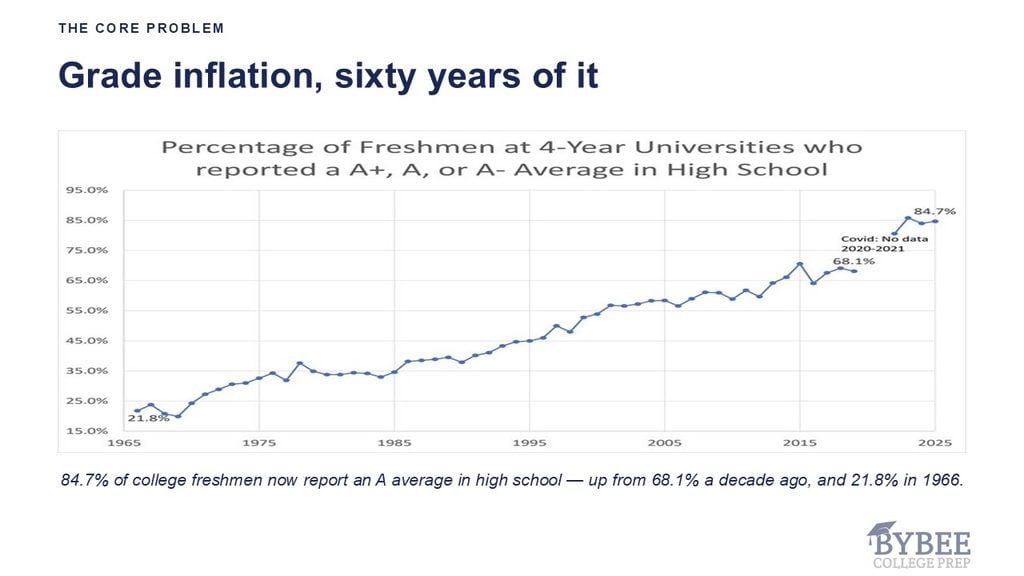
So when today’s parent pulls up a report card full of A’s, they read it the way they were trained to: their student is doing great. Then that same student sits for the SAT and struggles to break 1100, and the parent starts looking for someone or something to blame. Maybe the test is flawed. Maybe their student is “a good student but a bad tester.”
Neither of those things is usually true.
The Test Is a Measuring Device, Not a Verdict
The SAT and ACT measure how well a student knows a specific set of core concepts, concepts that research has identified as essential for success in college. They’re not measuring creativity, work ethic, or potential. They’re measuring current mastery of material, the same way a bathroom scale measures weight. We may not like what the scale tells us, but that doesn’t mean the scale is broken.
And the data backs up why that measurement matters. Research discussed by test-prep expert David Blobaum found that at highly selective schools, SAT and ACT scores alone are nearly four times more predictive of a student’s first-year college GPA than high school grades alone. That’s not a knock on grades. It’s a reminder that the two are measuring different things, and a test score is telling you something a report card can’t.
Why Grades Don’t Always Reflect Mastery
Grades today often reflect things other than simple mastery. They measure whether a student turned things in on time, followed the directions exactly, and stayed organized. My own son recently got a 94 on an assignment called “All About Me” in science. I was baffled. What was the 6% of himself he didn’t know?
Turns out he illustrated his favorite season but forgot to label it. He knew the answer. He just didn’t follow the instructions to the letter.
Multiply that across a school year, and across every teacher’s gradebook, and you start to see the problem. Teachers are managing an enormous number of students with real pressure to grade and return work quickly. Add in the need to protect against AI-generated work, and grading has increasingly shifted toward quick, in-class, multiple-choice-style assessments rather than the kind of deep, applied work that actually reflects mastery.
It’s Not Anxiety. It’s a Gap.
This is why “test anxiety” is often the wrong diagnosis. In most cases, a lower-than-expected score isn’t about nerves or a flawed test. It’s that a student hasn’t yet had enough practice applying what they know under conditions set by a third party, with no partial credit for effort or good intentions.

That gap is exactly what good test preparation closes. It’s not about tricking a test or memorizing shortcuts. It’s about teaching students how to apply what they already know to the specific format and demands of the SAT or ACT, while identifying and filling in the real gaps in their knowledge along the way.
Let’s Map Out the Plan
If your student’s scores don’t seem to match their grades, that’s not a red flag about your student. It’s information. The next step is figuring out exactly where the gap is and building a plan to close it. In a free consultation, we’ll look at your student’s current scores against their goals and map out a plan to get them where they need to be. Schedule your free consultation here.
Further reading:
- Test-Optional Admissions Do a Disservice to US Students — David Blobaum’s own piece laying out the 3.9x predictive-validity figure and what it means for families.
- The American Freshman: National Norms — the annual survey behind the 60-year self-reported high school GPA trend data.